Growing Together in What We Do
Russia
On October 9th a team of child care professionals will head to St.Petersburg Russia. Our host will be The Institute of Special Education and Special Psychology at the Raoul Wallenberg International University.
The participants will exchange ideas, concepts, applications and presentation for use by Russian faculty and students in their daily personal development. This exchange in methodic’ will be brought to practical application with visits to special needs orphanages were the Canadian and Russian professionals will assist the caregivers.
Our Canadian counterparts will create a future opportunity for arranging further exchange with the International University at a later date to further this relationship. Topics being covered are Social Worker training, Education and Psychology of Pre-schoolers with disabilities, Child counseling, Play therapy, Child Psychology and other disciplines.
We would like to thank the participants for volunteering and taking time away from their families as well as their practices for this program. Mission of T.E.A.R.S. has been partnering in educational and humanitarian programs for 17 years in Russia.
Landscape and Climate
|
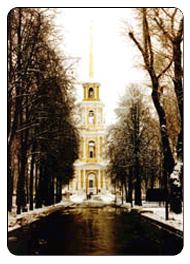 Russia is the world's largest country. It stretches across Europe and Asia and covers almost one-eighth of the world's land area. It takes a week to cross Russia by train, and there are eleven time zones from east to west. Russia is the world's largest country. It stretches across Europe and Asia and covers almost one-eighth of the world's land area. It takes a week to cross Russia by train, and there are eleven time zones from east to west. Russia's European neighbours to the northwest are Finland and Norway, and its Asian neighburs are North Korea, China, Mongolia and Kazakstan to the south. Azerbaijan and Georgia border the southwest. To the west are Ukraine, Belarus, Latvia and Estonia. Kaliningrad, which is geographically separated from the rest of Russia, is on the Baltic Sea with Lithuania to the north and east and Poland to the south.
|
|
| European Russia is a large plain, crossed by rivers such as the Volga and the Don. The Ural Mountains run from north to south and separate European and Asian Russia. Most Russians live in the European part of the country. |
|
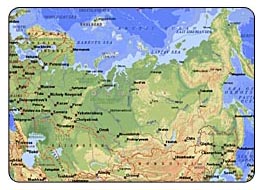 To the east of the Urals lies the region known as Siberia. Western Siberia near the Urals is low and swampy, rising to rolling hills farther east and to mountains and volcanoes near the Pacific coast. Along the southern border of Russia, between the Black Sea and the Caspian Sea, are the Caucasus Mountains. Siberia is crossed by four great rivers: the Ob (the fourth largest river in the world), the Irtysh, the Yenisei and the Lena. All run north to the Arctic Ocean. Lake Baikal in Siberia is the world?s deepest lake; it contains 20% of all the fresh water in the world. To the east of the Urals lies the region known as Siberia. Western Siberia near the Urals is low and swampy, rising to rolling hills farther east and to mountains and volcanoes near the Pacific coast. Along the southern border of Russia, between the Black Sea and the Caspian Sea, are the Caucasus Mountains. Siberia is crossed by four great rivers: the Ob (the fourth largest river in the world), the Irtysh, the Yenisei and the Lena. All run north to the Arctic Ocean. Lake Baikal in Siberia is the world?s deepest lake; it contains 20% of all the fresh water in the world.
|
|
Northern Russia is like northern Canada, an arctic region of tundra and permafrost. South of the tundra are coniferous forests. The plains in European Russia and the western part of Siberia are known as the steppes. These grasslands are used for agriculture..
|
|
|
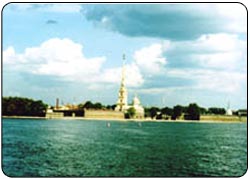
Winters vary from cool along the Black Sea coast to extremely cold in Siberia. The far north is snow-covered most of the year. Summers vary from warm in the steppes to cool along the Arctic coast. In eastern Russia, the hottest months are July and August. The days are long and sunny, and people spend a lot of their time outdoors. |
|
|
|
Official Name:
|
Russian Federation (Rossiyskaya Federatsiya) or Russia (Rossiya)
|
|
Capital:
|
Moscow
|
|
Type of Government:
|
Multiparty republic
|
|
Population:
|
149 million
|
|
Area:
|
17 million sq. km
|
|
Major Ethnic Groups:
|
Russian, Tatar, Ukrainian, Chuvash, Bashkir, Byelorussian, Moldavian
|
|
Language:
|
Russian
|
|
Religions:
|
Russian Orthodoxy, Islam, Judaism, Protestantism, Roman Catholicism, Buddhism
|
|
Unit of Currency:
|
Ruble
|
|
National Flag:
|
Three equal horizontal bands of white, blue and red
|
|
Federation established:
|
August 24, 1991
|
|
Russia's population of about 150 million comprises of people from diverse origins, cultures, languages and religions. The majority of the population is Russian and of a Caucasian descent. Russian is the official language besides 100 other spoken languages and dialects.
Economic growth in Russia has been steady over the past six years, but poverty remains widespread outside Moscow and St. Petersburg, especially among women and families with children.
Russia is experiencing a rapidly growing HIV/AIDS epidemic. As many as one in five children born to HIV-positive mothers are abandoned at birth. Domestic violence causes several thousand children to flee their homes and half a million children reside in orphanages; termination of parental rights being a leading reason. In the strife torn regions of Chechnya and Ingushetia, the rates of poverty and infant mortality are twice the national average and children are exposed to war, physical and sexual violence.
The Mission of TEARS humanitarian program grew out of its initial work with orphaned children in Russia in 1993.
Contact Us for how you can get involved in international ministry.
|
